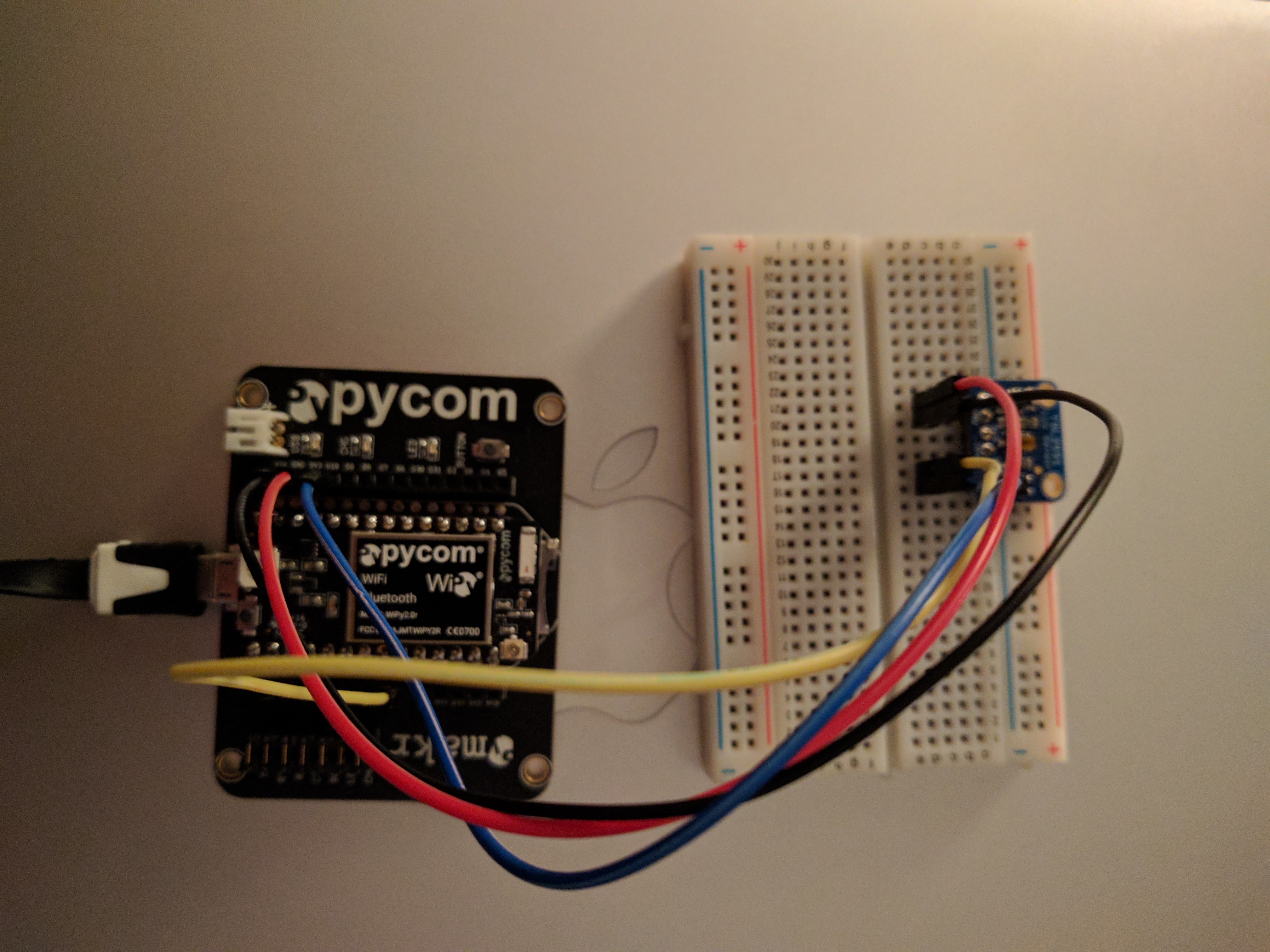
Getting acclimated to the WiPy 2.0 and Expansion Board. My first "hello world" if you will is to get a TSL2591 Light Sensor running. It is an i2c device.
Initial Notes on WiPy 2.0 Setup:
- Datasheet for Expansion Board are difficult to understand. I assumed that the pinouts would closely resemble that of the WiPy 2.0 but they are not even close. I am still working with the Expansion Board but dread pulling the WiPy 2.0 off of it and having to rework the circuit
- ATOM w/Pymkr is flakey at best. Sync Folder setting not working for me. I find myself having to restart ATOM after a while as it stops responding often.
- Firmware Upgrade Fails: I think? Can't tell what the latest firmware should be so I am not sure what, if anything happened.
- Connection with ATOM via IP address never worked. USB connection is working great.
TSL2991 Code:
Stole this from https://github.com/maxlklaxl/python-tsl2591
Out of the box this code did not work with the WiPy 2.0. After debugging a bit it turns out the pin outs for SDA and SCL needed to be changed.
Code Snippet (line 52ish of tsl2951.py that I changed to work with WiPy 2.0
[sourcecode language="python" wraplines="false" collapse="false"]
from machine import I2C, Pin
class SMBusEmulator:
__slots__ = ('i2c',)
def __init__(self):
self.i2c = I2C(pins=("P8", "P23")) #SDA SCL respectively
[/sourcecode]
Full Code:
[sourcecode language="python" wraplines="false" collapse="false"]
# tsl2591 lux sensor interface
import time
VISIBLE = 2
INFRARED = 1
FULLSPECTRUM = 0
ADDR = 0x29
READBIT = 0x01
COMMAND_BIT = 0xA0
CLEAR_BIT = 0x40
WORD_BIT = 0x20
BLOCK_BIT = 0x10
ENABLE_POWERON = 0x01
ENABLE_POWEROFF = 0x00
ENABLE_AEN = 0x02
ENABLE_AIEN = 0x10
CONTROL_RESET = 0x80
LUX_DF = 408.0
LUX_COEFB = 1.64
LUX_COEFC = 0.59
LUX_COEFD = 0.86
REGISTER_ENABLE = 0x00
REGISTER_CONTROL = 0x01
REGISTER_THRESHHOLDL_LOW = 0x02
REGISTER_THRESHHOLDL_HIGH = 0x03
REGISTER_THRESHHOLDH_LOW = 0x04
REGISTER_THRESHHOLDH_HIGH = 0x05
REGISTER_INTERRUPT = 0x06
REGISTER_CRC = 0x08
REGISTER_ID = 0x0A
REGISTER_CHAN0_LOW = 0x14
REGISTER_CHAN0_HIGH = 0x15
REGISTER_CHAN1_LOW = 0x16
REGISTER_CHAN1_HIGH = 0x17
INTEGRATIONTIME_100MS = 0x00
INTEGRATIONTIME_200MS = 0x01
INTEGRATIONTIME_300MS = 0x02
INTEGRATIONTIME_400MS = 0x03
INTEGRATIONTIME_500MS = 0x04
INTEGRATIONTIME_600MS = 0x05
GAIN_LOW = 0x00
GAIN_MED = 0x10
GAIN_HIGH = 0x20
GAIN_MAX = 0x30
def _bytes_to_int(data):
return data[0] + (data[1]\<\<8)
from machine import I2C, Pin
class SMBusEmulator:
__slots__ = ('i2c',)
def __init__(self):
self.i2c = I2C(pins=("P8", "P23"))
def write_byte_data(self, addr, cmd, val):
buf = bytes([cmd, val])
self.i2c.writeto(addr, buf)
def read_word_data(self, addr, cmd):
assert cmd \< 256
buf = bytes([cmd])
self.i2c.writeto(addr, buf)
data = self.i2c.readfrom(addr, 4)
return _bytes_to_int(data)
SENSOR_ADDRESS=0x29
class Tsl2591:
def __init__(
self,
sensor_id,
integration=INTEGRATIONTIME_100MS,
gain=GAIN_LOW
):
print(sensor_id)
self.sensor_id = sensor_id
self.bus = SMBusEmulator()
self.integration_time = integration
self.gain = gain
self.set_timing(self.integration_time)
self.set_gain(self.gain)
self.disable()
def set_timing(self, integration):
self.enable()
self.integration_time = integration
self.bus.write_byte_data(
SENSOR_ADDRESS,
COMMAND_BIT | REGISTER_CONTROL,
self.integration_time | self.gain
)
self.disable()
def set_gain(self, gain):
self.enable()
self.gain = gain
self.bus.write_byte_data(
SENSOR_ADDRESS,
COMMAND_BIT | REGISTER_CONTROL,
self.integration_time | self.gain
)
self.disable()
def calculate_lux(self, full, ir):
if (full == 0xFFFF) | (ir == 0xFFFF):
return 0
case_integ = {
INTEGRATIONTIME_100MS: 100.,
INTEGRATIONTIME_200MS: 200.,
INTEGRATIONTIME_300MS: 300.,
INTEGRATIONTIME_400MS: 400.,
INTEGRATIONTIME_500MS: 500.,
INTEGRATIONTIME_600MS: 600.,
}
if self.integration_time in case_integ.keys():
atime = case_integ[self.integration_time]
else:
atime = 100.
case_gain = {
GAIN_LOW: 1.,
GAIN_MED: 25.,
GAIN_HIGH: 428.,
GAIN_MAX: 9876.,
}
if self.gain in case_gain.keys():
again = case_gain[self.gain]
else:
again = 1.
cpl = (atime * again) / LUX_DF
lux1 = (full - (LUX_COEFB * ir)) / cpl
lux2 = ((LUX_COEFC * full) - (LUX_COEFD * ir)) / cpl
return max([lux1, lux2])
def enable(self):
self.bus.write_byte_data(
SENSOR_ADDRESS,
COMMAND_BIT | REGISTER_ENABLE,
ENABLE_POWERON | ENABLE_AEN | ENABLE_AIEN
)
def disable(self):
self.bus.write_byte_data(
SENSOR_ADDRESS,
COMMAND_BIT | REGISTER_ENABLE,
ENABLE_POWEROFF
)
def get_full_luminosity(self):
self.enable()
time.sleep(0.120*self.integration_time+1)
full = self.bus.read_word_data(
SENSOR_ADDRESS, COMMAND_BIT | REGISTER_CHAN0_LOW
)
ir = self.bus.read_word_data(
SENSOR_ADDRESS, COMMAND_BIT | REGISTER_CHAN1_LOW
)
self.disable()
return full, ir
def get_luminosity(self, channel):
full, ir = self.get_full_luminosity()
if channel == FULLSPECTRUM:
return full
elif channel == INFRARED:
return ir
elif channel == VISIBLE:
return full - ir
else:
return 0
def sample(self):
full, ir = self.get_full_luminosity()
return self.calculate_lux(full, ir)
[/sourcecode]
Simple main.py to print out 10 sensor readings. Hello World Complete!
Will work on posting to the cloud/thingspeak or something of that nature next
[sourcecode language="python" wraplines="false" collapse="false"]
# main.py -- put your code here!
import time
from machine import Pin
from machine import I2C
import tsl2591
tsl = tsl2591.Tsl2591(0) # initialize tls2591
cnt = 0
while cnt != 10:
time.sleep(2)
full, ir = tsl.get_full_luminosity() # read raw values (full spectrum and ir spectrum)
lux = tsl.calculate_lux(full, ir) # convert raw values to lux
print(lux, full, ir)
cnt = cnt + 1
[/sourcecode]